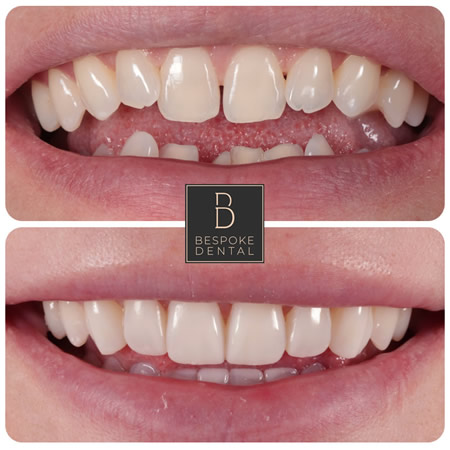
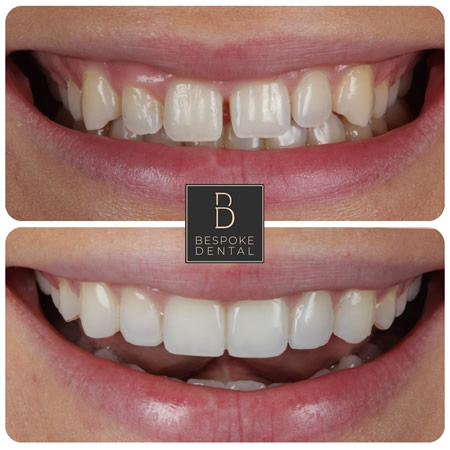
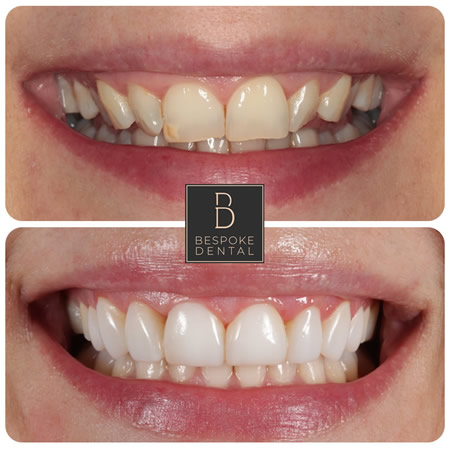
If you’re looking for a way to straighten your teeth without anyone noticing, Invisalign may be the perfect solution for you. Invisalign is a clear aligner system that gradually shifts your teeth into their correct positions. Not only are they virtually invisible, but they’re also removable. This makes it much easier to maintain good oral hygiene than with traditional braces, which can be difficult to clean around.
Unlike other clear aligner treatments, Invisalign is backed by years of research and development, and it has a proven track record of success. It is a highly effective treatment for a wide range of orthodontic issues, including crowded teeth, gaps, overbites, underbites, open bites and crossbites.

Straighter teeth in 7 weeks or your money back!
Combining Invisalign, whitening and Composite Bonding is a popular treatment choice. The reason for this is because Invisalign will make the teeth look straight, but it will not improve the shape or colour of the teeth – this is where whitening and Composite Bonding come in! We improve the colour of the teeth with teeth whitening before using Composite Bonding to make the teeth ‘look pretty’.
We often have to do Invisalign before Composite Bonding to:
Correct bite issues: Problems with the bite can cause cracking or chipping of the Composite.
Correct crowding: Get the teeth in better positions for Composite Bonding.


Dr Douglas Macmillan

Dr Raffaele Cedrola

Dr Ameena Awan
The Invisalign team at Bespoke Dental in Reading includes Dr Douglas Macmillan (GDC No: 278922), Dr Raffaele Cedrola (GDC No: 278793) and Dr Ameena Awan (GDC No: 277783) – all three dentists have extensive cosmetic and restorative dentistry experience.



Contact our Treatment Coordinator to book your FREE Invisalign consultation (Worth £250).


Our commitment to transparent pricing ensures that our patients are fully informed of all treatment costs upfront, with no hidden fees. During your consultation, we will discuss these costs, and we can offer 0% interest payment plans to make treatment more affordable.
From £29 per month
From £52 per month
From £73 per month
From £83 per month
* Treatment times may vary. These figures are to be used as a guide only.
Use this calculator to get a quick, illustrative example of how much repayments could be for your treatment.
We are always happy to answer any questions or concerns you may have.
Having straight teeth not only improves your smile but also has a significant impact on your oral health.
When your teeth are straighter, it becomes easier to maintain good oral hygiene, which can prevent many dental issues. Straight teeth are less likely to accumulate plaque and bacteria, reducing the risk of tooth decay and gum disease. A healthy mouth also leads to better overall health and well-being.
Aside from the dental benefits, having straighter teeth can also boost your self-confidence. Additionally, straighter teeth can improve your bite, which can alleviate jaw pain and headaches. Misaligned teeth can put pressure on your jaw muscles, leading to pain and discomfort. Straightening your teeth can relieve this pressure and improve your overall dental function.
Finally, orthodontic treatment to straighten your teeth can also improve your speech. Crooked teeth or a misaligned jaw can affect how you speak, leading to difficulty pronouncing certain words or sounds. Straightening your teeth can correct these issues, leading to clearer speech and improved communication.
Overall, the benefits of straighter teeth are numerous and far-reaching, from improved oral health to increased self-confidence and better overall well-being.
Book your free consultation by clicking here and completing the contact form.
Invisalign treatment time varies in length depending on the complexity of your case. Some patients may see results in as little as three months, while others may need treatment for up to two years. It’s important to follow your dentist’s instructions and wear your aligners for the recommended amount of time each day to ensure the best results in the shortest amount of time. Your dentist will also schedule regular check-ups to monitor your progress and make any necessary adjustments to your treatment plan.
One of the most common questions that people have about Invisalign is whether it is painful.
The short answer is that Invisalign is not usually painful, but you may experience some mild discomfort during the treatment process.
When you first start wearing Invisalign aligners, you may feel some pressure or tightness as your teeth begin to move into their new positions. This is a normal part of the process, and the discomfort usually goes away within a few days. Some people may also experience some soreness or irritation on their gums or tongue from the edges of the aligners.
However, it is important to remember that you can take your aligners out at any point if you are experiencing any discomfort!
You should wear your aligners for a minimum of 22 hours each day.
Invisalign can treat a huge range of cases, however there will be a select few patients for whom we will advise traditional braces be used.
Yes, it is highly recommended to wear your retainers after finishing Invisalign treatment. Retainers are an important part of the orthodontic treatment process as they help maintain the results achieved with Invisalign.
After completing your Invisalign treatment, your teeth will have been moved into their new positions. However, they will not be fully settled in their new positions and will have a tendency to shift back to their original positions if not held in place. This is where retainers come in.
Retainers help prevent teeth from shifting back to their original positions by holding them in their new positions. Depending on your specific case, your dentist may recommend wearing your retainers full-time for a certain period, followed by wearing them only at night.
It’s important to follow your dentist’s instructions on wearing your retainers to ensure that your teeth remain in their new positions. Neglecting to wear your retainers as instructed can cause your teeth to shift back, undoing the progress made during Invisalign treatment.
In summary, wearing your retainers after finishing Invisalign treatment is an essential step in maintaining the results achieved with Invisalign. Follow your dentist’s instructions on wearing your retainers to ensure that your new smile stays beautiful and healthy for years to come.
Invisalign offers several benefits over traditional braces, including:
Aesthetics:
Invisalign aligners are virtually invisible, which means they are more aesthetically pleasing than traditional braces. They allow patients to maintain a natural appearance during treatment, without drawing unwanted attention to their teeth.
Comfort:
Invisalign aligners are made from a smooth plastic material, which is more comfortable to wear than traditional braces. Unlike braces, which have brackets and wires that can irritate the mouth, Invisalign aligners are custom-made to fit snugly over the teeth, causing minimal discomfort.
Convenience:
Invisalign aligners are removable, which means patients can easily take them out when they need to eat, brush, or floss. This makes maintaining oral hygiene during treatment much easier than with traditional braces.
Shorter treatment time:
In some cases, Invisalign treatment can be completed in less time than traditional braces. The average treatment time for Invisalign is between 12-18 months, whereas traditional braces can take up to two years or more to achieve the desired results.
Predictable results:
Invisalign aligners are designed using 3D imaging technology, which allows our dentists to create a precise treatment plan for each patient. This technology ensures that the aligners will gradually shift the teeth into the desired position, resulting in predictable and effective results.
Overall, Invisalign offers many benefits over traditional braces, making it an attractive treatment option for many patients seeking orthodontic care.
We include free retainers, home teeth whitening and a home care pack.
These are small tooth coloured buttons of composite which are glued to the surfaces of the teeth and removed after the treatment is completed. They are used to provide extra grip for the aligners to make tooth movements more efficient.